The Research Behind DRX9000 Spinal Decompression
This page collects five peer-reviewed publications on non-surgical spinal decompression with the DRX9000: a 267-patient retrospective chart review, a 30-patient retrospective cohort study, a lumbar case series, a single-patient cervical case report, and a chronic low-back-pain outcomes paper. Across these studies the outcomes measured are pain scores, disability and function, and disc height on follow-up imaging.
At TriMed Spine & Joint, our DRX9000 protocol is grounded in published clinical evidence. The studies below represent the peer-reviewed foundation for non-surgical spinal decompression — including clinical studies, outcome studies, and case series from leading academic institutions.
What the Research Shows About DRX9000 Spinal Decompression
Published studies of non-surgical spinal decompression report reduced pain, improved function, and in several trials measurable increases in disc height on follow-up imaging. Results vary from patient to patient, and no study below predicts or guarantees an individual outcome.
For how this treatment is delivered in practice, see DRX9000 spinal decompression at TriMed Spine & Joint.
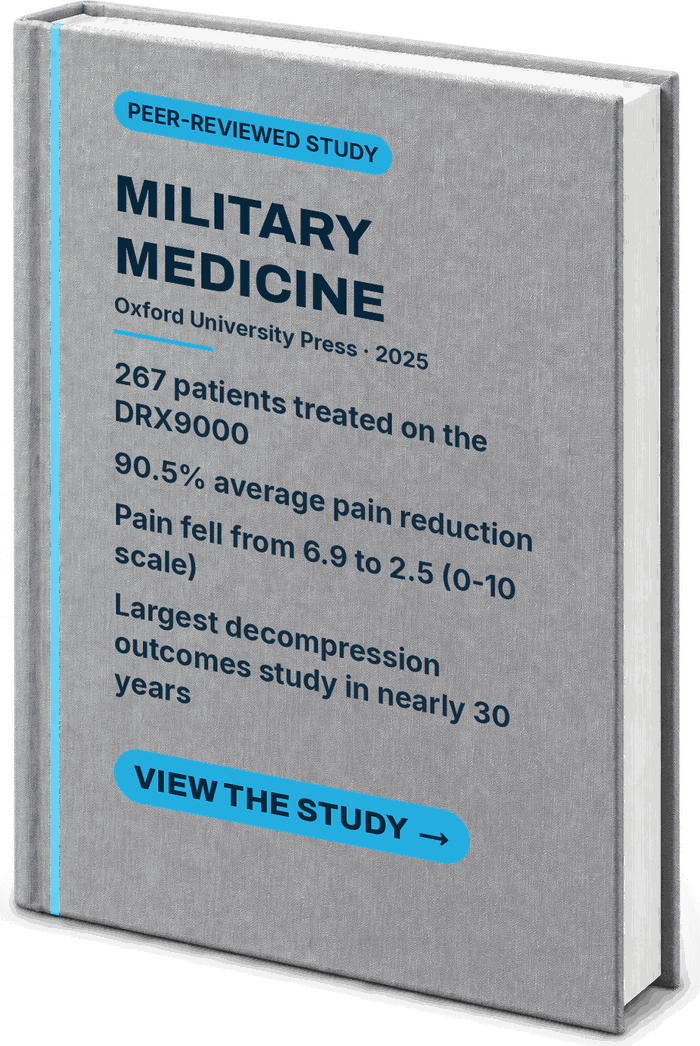
2025 retrospective chart review of 267 patients: 90.5% reported pain reduction after non-surgical spinal decompression
A 2025 retrospective chart review published in Military Medicine (Oxford University Press) analyzed 267 patient records from 7 clinics. Pain scores fell from an average of 6.9 to 2.5, and 90.5% of patients reported pain reduction following non-surgical spinal decompression.
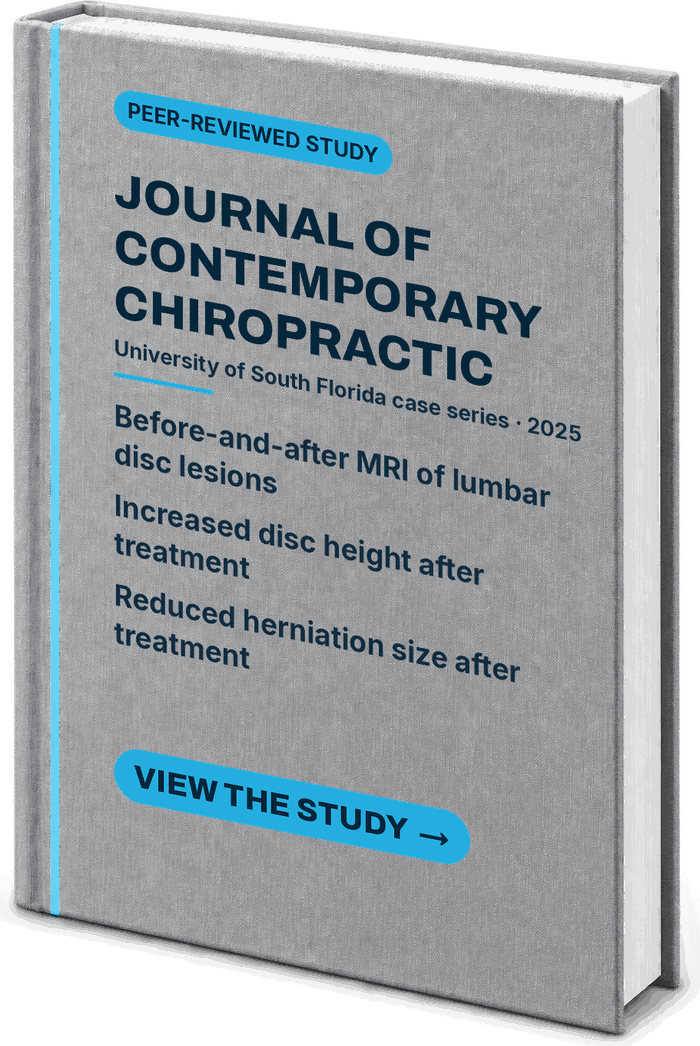
2025 lumbar case series: 80% improvement in pain and measurable disc height increase on MRI
A University of South Florida case series published in the Journal of Contemporary Chiropractic (Vol. 8, Issue 1, 2025) reported an 80% improvement in pain (p<0.001), a 50% reduction in disability, and 75% subjective recovery after non-surgical spinal decompression for lumbar intervertebral disc lesions. Post-treatment MRI, reviewed by two independent radiologists, showed disc height increases of 1.0–1.6mm, and 77% of patients showed measurable herniation reduction.
J. Physical Medicine 2026
2026 cervical case report: disc height change after DRX9000C decompression in a patient with multiple sclerosis
A single-patient case report from University of South Florida Health, Department of Neurosurgery, Brain and Spine, published in the Journal of Physical Medicine and Rehabilitation (2026), documented cervical disc outcomes following DRX9000C non-surgical spinal decompression in a patient with multiple sclerosis. The report includes measurable disc height changes on post-treatment imaging.
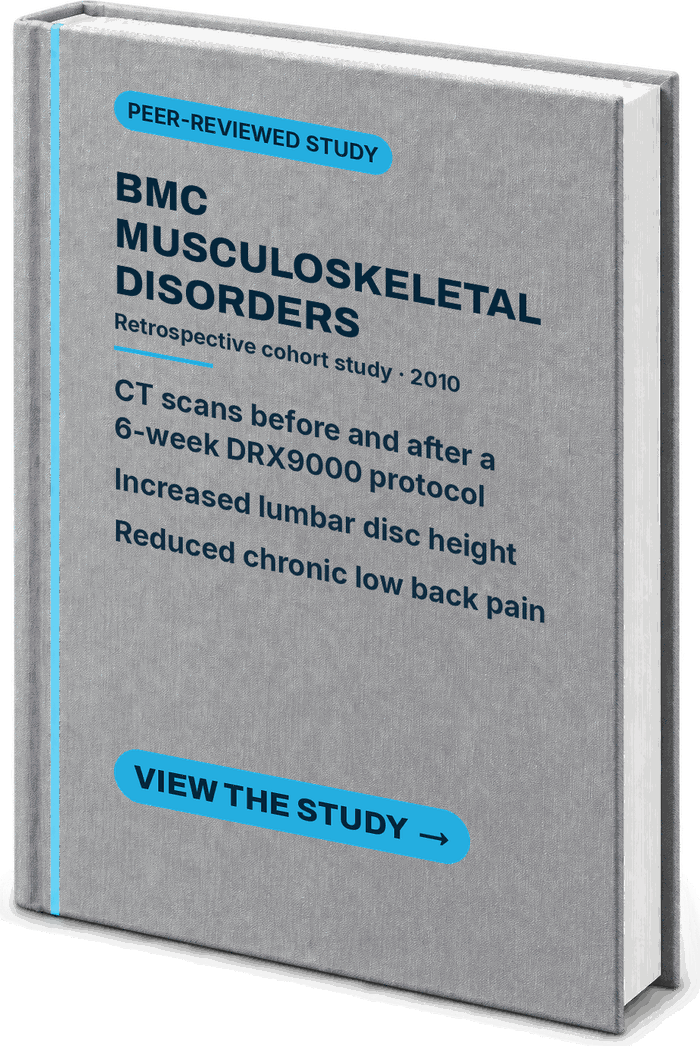
2010 study: restored disc height associated with decreased discogenic low back pain
A retrospective cohort study of 30 patients, conducted by Apfel and colleagues at the University of California, San Francisco and published in BMC Musculoskeletal Disorders (2010;11:155), found that non-surgical spinal decompression was associated with restored disc height and decreased discogenic low back pain. Pain scores fell from 6.2 to 1.6 and average lumbar disc height increased from 7.5mm to 8.8mm (p<0.001).
European Musculoskeletal Review 2008
2008 study: average lumbar disc height increased 1.6mm and pain scores fell from 5.7 to 0.8
In a study of DRX9000 non-surgical spinal decompression for chronic low back pain published in European Musculoskeletal Review (2008;3(1)), average lumbar disc height increased by 1.6mm. Pain scores decreased from 5.7 to 0.8 on a 0–10 scale and range-of-motion pain scores decreased from 5.6 to 0.7.
Want to Know If You’re a Candidate?
DRX9000 spinal decompression is used for disc-related conditions of the low back and neck — herniated discs, bulging discs, degenerative disc disease and posterior facet syndrome. It is not appropriate for everyone: pregnancy, prior lumbar fusion or spinal instrumentation, severe osteoporosis, unstable spondylolisthesis, metastatic cancer and other conditions generally rule it out, and that list is not exhaustive. Candidacy is decided in person, after an examination and a review of your imaging — you can read the full criteria in our guide to how the DRX9000 works and who it is for.
Bring your MRI. Dr. Cantor will review your imaging and give you a straight answer.
The studies cited above are published peer-reviewed research; citation does not imply endorsement by study authors of TriMed Spine & Joint or its protocols. Individual patient outcomes may vary. In compliance with Florida § 456.062.