Published by TriMed Spine & Joint — Boca Raton, Delray Beach, Lauderhill & Hollywood, FL
Quick summary: Concussions are among the most commonly missed injuries after a car accident. You don’t have to hit your head, and you don’t have to black out — the whip-like force of a collision alone can injure the brain, and symptoms often don’t appear for days. At TriMed Spine & Joint, we screen crash patients with the EyeBOX®, an FDA-cleared eye-tracking device that objectively detects the eye-movement abnormalities concussion causes — with no baseline test, no needles, and no radiation.
Why Head Injuries Get Overlooked After a Crash
Think about what happens in the hours after an accident. Police reports. Tow trucks. Insurance calls. Adrenaline is surging — which literally masks pain and symptoms. If you go to the ER, their job is to rule out life-threatening emergencies: a CT scan checks for bleeding and fractures, it comes back clean, and you’re discharged.
Here’s the problem: a normal CT scan does not rule out a concussion. CT shows structure — bleeding, broken bone. Concussion is a functional injury: the brain’s wiring is disrupted, not its architecture. Structure looks fine; function isn’t.
Three more reasons concussions slip through the cracks:
- No head impact required. The same acceleration-deceleration force that whips your neck also moves your brain inside your skull. You can sustain a concussion without your head touching anything.
- No blackout required. Most concussions involve no loss of consciousness at all. “I never got knocked out” is not the same as “I’m not concussed.”
- Symptoms hide behind whiplash. Headache, dizziness, neck pain, trouble sleeping — concussion and whiplash share symptoms, so one routinely hides behind the other unless a provider screens for both.
The Symptoms People Write Off as “Stress”
Concussion symptoms typically surface 24–72 hours after the crash — sometimes later. Patients tell us things like “I figured I was just shaken up.” Watch for:
- Headaches that linger or worsen
- Brain fog — trouble concentrating, forgetting words, losing your train of thought
- Sensitivity to light or noise
- Dizziness or balance problems
- Irritability, anxiety, or mood changes that feel “not like you”
- Unusual fatigue or disrupted sleep
Red flags are different. A headache that keeps getting worse, repeated vomiting, slurred speech, unusual confusion or drowsiness, weakness or numbness, or one pupil larger than the other — those mean emergency room, immediately.
What Is the EyeBOX?
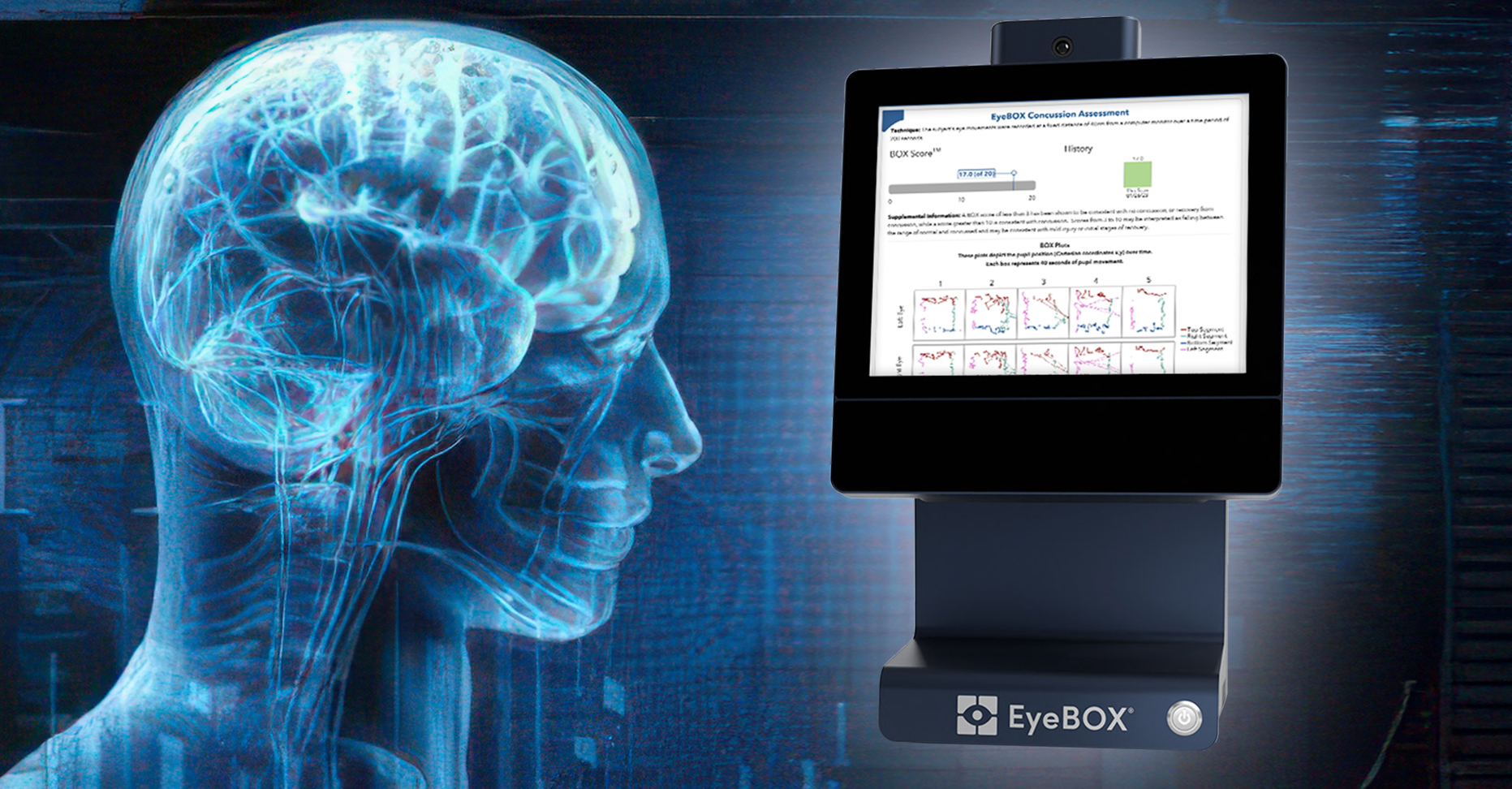
For decades, concussion assessment relied on subjective tools: symptom checklists you fill out yourself, and the clinical equivalent of “follow my finger.” Both depend on what the patient reports and what the examiner’s eye can catch.
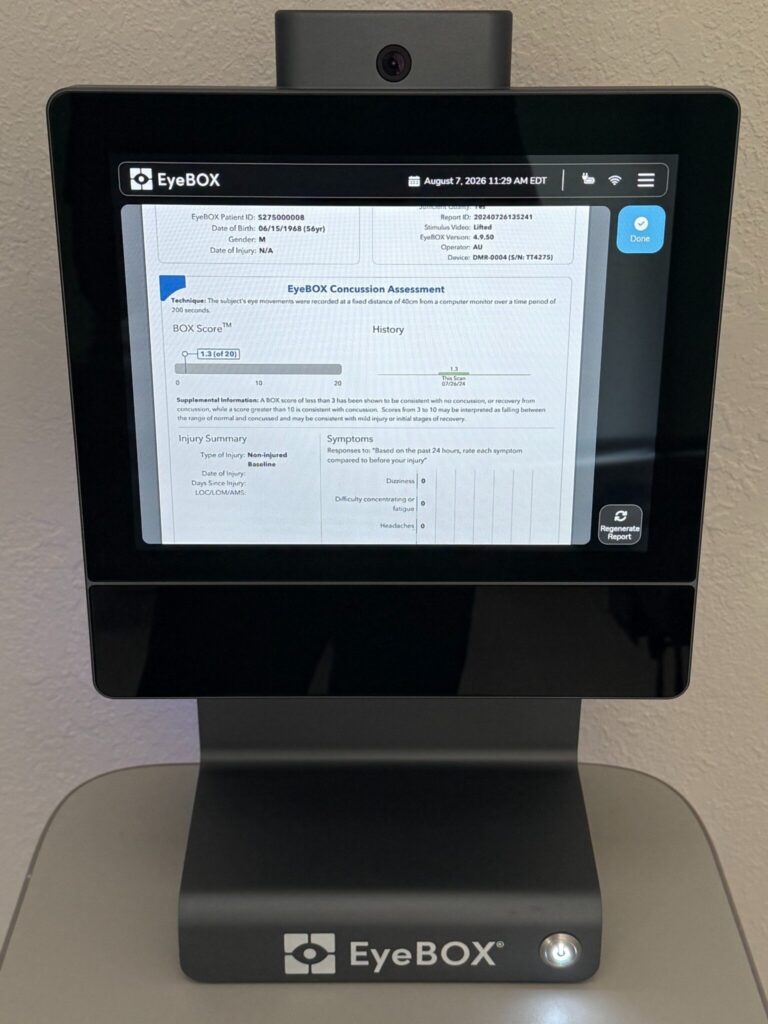
The EyeBOX®, made by Oculogica, changed that. It’s an FDA-cleared eye-tracking device — the first cleared as an aid in diagnosing concussion that requires no pre-injury baseline test. That distinction matters enormously after a car accident: athletes get preseason baseline tests, but nobody has a “before the crash” measurement on file. The EyeBOX doesn’t need one.
How the EyeBOX Test Works
The science is elegant. Concussion disrupts the cranial nerves that control your eye movements — in ways too subtle for a human examiner to see, but not too subtle for a high-speed camera.
Here’s the entire test from the patient’s side:
- You sit down and rest your chin and forehead on a comfortable support, like at the eye doctor.
- You watch a short video that moves slowly around the edge of a screen. That’s your whole job.
- A high-speed infrared camera just below the screen records your eye positions hundreds of times per second — hundreds of thousands of data points in one sitting.
- The device’s algorithm analyzes your eye movements for the specific abnormalities concussion produces and generates a BOX Score, an objective measurement compared against an age- and gender-normalized population.
- Your provider interprets the score alongside a clinical neurological exam to reach a diagnosis.
No needles. No radiation. No effort, no test anxiety, nothing to “pass or fail.” Just watching a screen.
Why Objective Testing Changes Everything
The BOX Score is based purely on measured eye movement — no symptom self-reporting goes into it. That matters in both directions:
- It catches the stoics. Plenty of patients minimize symptoms — they want to get back to work, they don’t want to seem fragile, they genuinely believe they’re fine. Their eye movements tell the truth anyway.
- It documents objectively. After an accident, your medical record matters. An FDA-cleared, machine-measured result is objective documentation of your injury — not just a checklist of what you said you felt.
- It tracks recovery. The EyeBOX is also cleared to help monitor concussion recovery over time, so follow-up testing can show measurable improvement rather than guesswork about when you’re truly healed.
Who Needs EyeBOX Testing?
The EyeBOX is FDA-cleared for patients ages 5 through 67, so children and adults from the same crash can both be screened. We recommend testing for:
- Anyone with post-crash symptoms — headaches, fog, dizziness, light sensitivity, mood or sleep changes — even if they started days after the accident.
- Anyone who hit their head or was violently jolted but “feels fine.” Objective screening can flag dysfunction before symptoms catch up.
- Parents and children from the same collision. Kids are notoriously poor at reporting concussion symptoms; an objective test doesn’t rely on their self-description.
- Patients already diagnosed with a concussion who need recovery monitored before returning to work, school, or sports.
The EyeBOX is a diagnostic aid used together with a clinical exam — not a standalone test — and anyone with red-flag symptoms belongs in the emergency room first, every time.
Frequently Asked Questions
Can I have a concussion without hitting my head?
Yes. The rapid acceleration-deceleration of a crash can cause the brain to move within the skull — no impact and no loss of consciousness required.
I had a normal CT scan at the ER. Doesn’t that mean I’m fine?
A normal CT rules out bleeding and fractures — emergencies. It does not rule out concussion, which is a functional injury that CT can’t see. That’s the gap EyeBOX screening fills.
Does the EyeBOX test hurt?
No. You simply watch a video while a camera tracks your eyes. Non-invasive, no needles, no radiation.
Do I need a baseline test from before my accident?
No. The EyeBOX is specifically designed to work without any pre-injury baseline — your results are compared against a normalized population instead.
Can my child be tested?
Yes. The EyeBOX is FDA-cleared for ages 5 through 67.
Is EyeBOX testing covered after a car accident?
In Florida, medically necessary crash-injury evaluation is generally billable under your PIP coverage. Remember that Florida’s 14-day rule requires initial medical care within 14 days of the accident to preserve your PIP benefits — another reason not to wait on symptoms. Our staff verifies your coverage before testing.
Hit Your Head — or Just Not Feeling Like Yourself Since the Crash?
Don’t write it off as stress. TriMed Spine & Joint offers EyeBOX® concussion screening as part of our comprehensive auto accident evaluations at four South Florida locations — Boca Raton, Delray Beach, Lauderhill, and Hollywood — alongside chiropractic, interventional pain management, and orthopedic spine care under one roof.
Call (855) 487-4633 or request an appointment online.
Medical disclaimer: This article is for general educational purposes and is not medical advice. The EyeBOX is an FDA-cleared aid in the diagnosis of concussion used in conjunction with a standard clinical neurological assessment; it is not a standalone diagnostic. Individual situations vary; consult a licensed provider about your specific condition. Pursuant to Florida law, the patient and any other person responsible for payment has a right to refuse to pay, cancel payment, or be reimbursed for payment for any other service, examination, or treatment that is performed as a result of and within 72 hours of responding to an advertisement for a free, discounted fee, or reduced fee service, examination, or treatment (§ 456.062, Fla. Stat.).
About Author
